When jaw pain is a bite problem, it is a prosthodontic problem.
Jaw pain, clicking, morning headaches, teeth that keep chipping. These often share one cause: a bite that no longer meets the way it was designed to. Dr. Mamaly Reshad is a prosthodontist, the specialty concerned with how teeth meet and function. He taught this subject as Chairman of Fixed Prosthodontics at USC, published the paper on how losing back-tooth support breaks down the front of the mouth, and has spent thirty years rebuilding bites that other treatment left in the wrong place. If your bite is causing the problem, or if you need work that depends on getting the bite right, this is where it should be diagnosed.

The joint
Where your teeth meet decides where your jaw rests
The jaw joint does not simply hinge. Open slowly and it does two things in sequence: for the first ten or eleven millimeters the condyle rotates in its socket, then it slides forward and down the slope of bone in front, the articular eminence, carrying its cushioning disc with it. Where the teeth meet at the end of that journey decides where the joint sits, how far it travels, and how hard the muscles work to hold it there.
Change the teeth and you change the joint's resting position. That is why a crown placed a fraction too high, a bite that has collapsed with wear, or a row of veneers designed for appearance alone can produce pain in a joint that was previously fine.
The animation is an illustration of the anatomy, not a scan and not a patient's joint.
Written by the person who taught the specialty
There is no shortage of "TMJ specialists" on this side of town. Look closely and most are general or cosmetic dentists offering a night guard and a course of adjustments. Some sell a philosophy. Very few can tell you, before touching a tooth, whether your bite is the cause of your pain, a contributor to it, or nothing to do with it.
Prosthodontics is the dental specialty concerned with how teeth meet and function together, covering the diagnosis, planning, rehabilitation and maintenance of oral function, comfort, appearance and health. When a jaw problem is driven by where the teeth meet, by a collapsed bite, or by restorative work that put the bite in the wrong place, it is prosthodontic work.
That distinction is the whole job, and it is what prosthodontists are trained for. Dr. Reshad's background in this subject is not a weekend course:
— Former Chairman of Fixed Prosthodontics and Operative Dentistry, Herman Ostrow School of Dentistry of USC, the department that teaches occlusion to the next generation of dentists.
— Author of The Influence of Posterior Occlusion When Restoring Anterior Teeth (Journal of the California Dental Association, 2008), on the exact mechanism behind most bite-driven jaw problems.
— Author of the textbook chapter Occlusion, Posterior Support, and Occlusal Overload in Implant Dentistry (forthcoming), which sets out the protocol described on this page, and of the chapter on full-arch framework design, material selection and clinical protocols in Full-Mouth Implant Reconstruction (Quintessence Publishing).
— Editorial board, Journal of Esthetic and Restorative Dentistry; clinical editor, Spectrum Dental Teamwork. Fellow of the International College of Dentists.
— Trained at King's College London and the Eastman Dental Institute (MSc with Distinction), then advanced prosthodontics at USC. Practices limited to prosthodontics in Los Angeles and London.
— Runs an international mentorship program in which dentists travel to Los Angeles to observe his cases.
In plain terms: the dentists who treat bites learned it from textbooks and departments he has contributed to. When the case is complicated, this is where it should start.
The pattern behind most of it: loss of posterior support
This is the mechanism Dr. Reshad published on in 2008 and has since written the textbook chapter on, and it explains the majority of bite-driven cases we see.
Back teeth are built to take the vertical load of closing. Front teeth are built to guide the jaw sideways and forward, and to separate the back teeth the moment you move. When back teeth wear, break, drift or are lost, that load transfers forward onto front teeth that were never designed to carry it. The upper front teeth are pushed outward, the bite opens at the front, and the height of the lower face closes down.
The jaw now rests where it was not designed to rest. The muscles work harder to hold it there. The joint is loaded at an angle it does not tolerate well. Patients describe pain in front of the ear, tightness through the temples, headaches on waking, clicking, and a jaw that is tired by evening.
This is a functional diagnosis, not a count of teeth. A mouth with a full complement of teeth can have lost its posterior support if those teeth are worn, drifted or periodontally weakened. The signs are specific: widening of the ligament space around a tooth on an x-ray; front teeth that shiver or move under a firm bite; restorations that fracture repeatedly in the same place; teeth drifting, or gaps opening between them; heavy or uneven wear.
Two or more together make the diagnosis. One alone does not, and a dentist who diagnoses a collapsed bite from a single worn tooth is guessing.
How much support is enough? The working baseline is eight back-tooth contacts, four each side, with a molar counting as two and a premolar as one. Some patients need considerably more: younger patients, heavy grinders, and anyone with weakened gum support. Some older patients function well with less, and the evidence supports leaving a shortened arch alone when nothing else is planned. The distinction that matters is this: a bite that is adequate for a mouth left as it is may be entirely inadequate for a mouth about to receive veneers, crowns or implants at the front. That is the calculation made before any of that work is offered here.
One rule follows from it, and it governs everything on this page: definitive front-tooth work does not proceed until posterior support is resolved. Veneers, crowns or implants placed at the front of an unsupported bite are taking forces they were never designed for, and they fail early. That sequence is not a preference. It is the reason cases last.
TMJ and occlusion: when the bite is the problem
Your jaw joints rest only where your teeth let them.
Jaw joint pain, clicking, locking and tired, aching jaw muscles have many causes, and the bite is not the main one for most people. But in a specific group of patients the bite is exactly the problem: a tooth that hits first, a bridge that was built too tall or too short, back teeth that no longer stop the jaw, front teeth that lock it in. Those cases do not get better with time or with a night guard alone, because every swallow and every chew pushes the joint off its seat. This segment explains how a bite can load a joint, how we find out whether yours does, and why a reconstruction has to be engineered so it never becomes the cause.
The short version
Seven ways a bite can load a jaw joint
Each one pushes the condyle, the ball of the joint, away from its seated position or makes the muscles hold it there by force. None of them shows up on an X-ray of the joint. They show up in the bite.
01
A tooth that hits first
02
No back stops
03
Wrong bite height
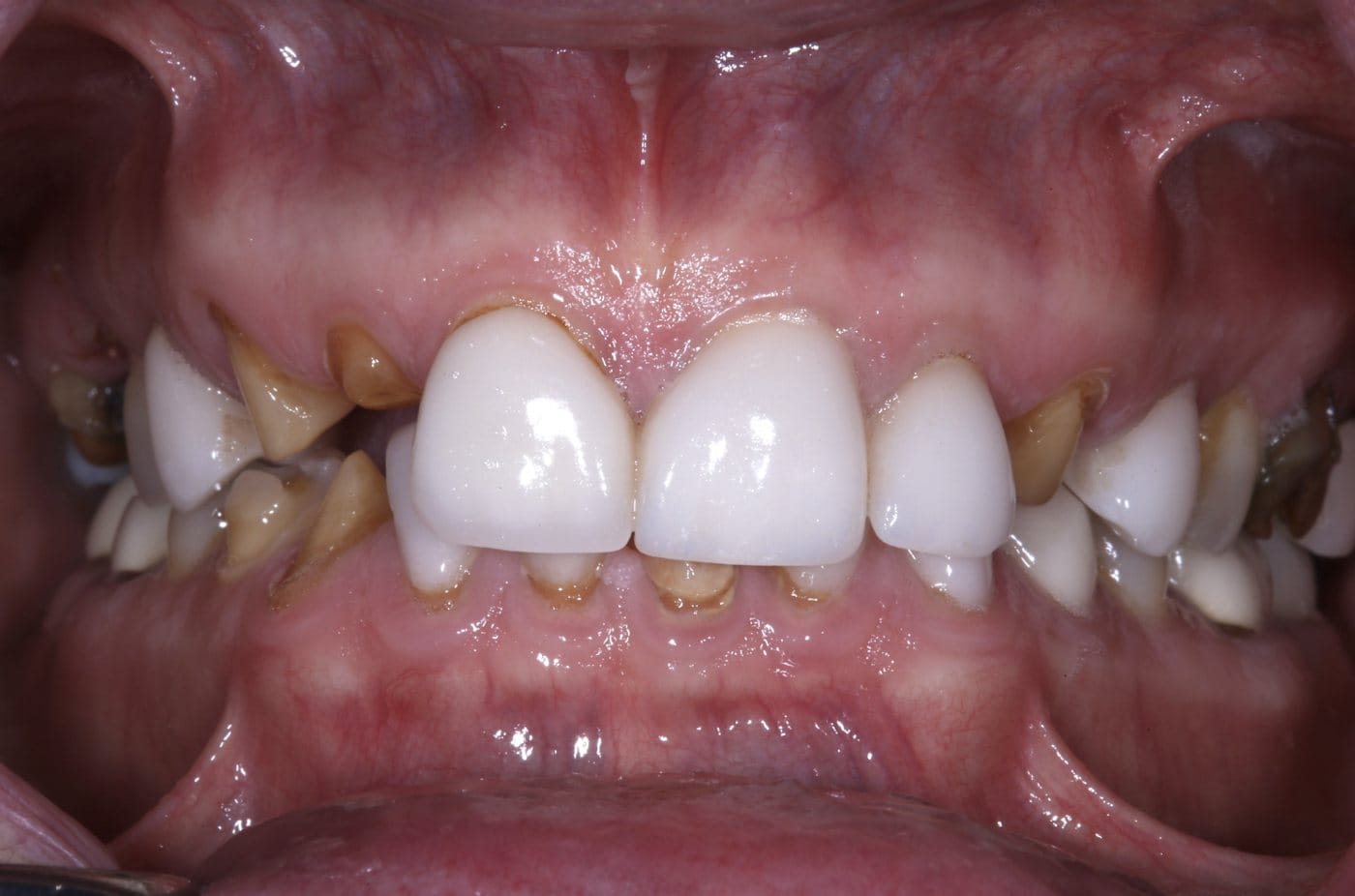
04
Locked in at the front
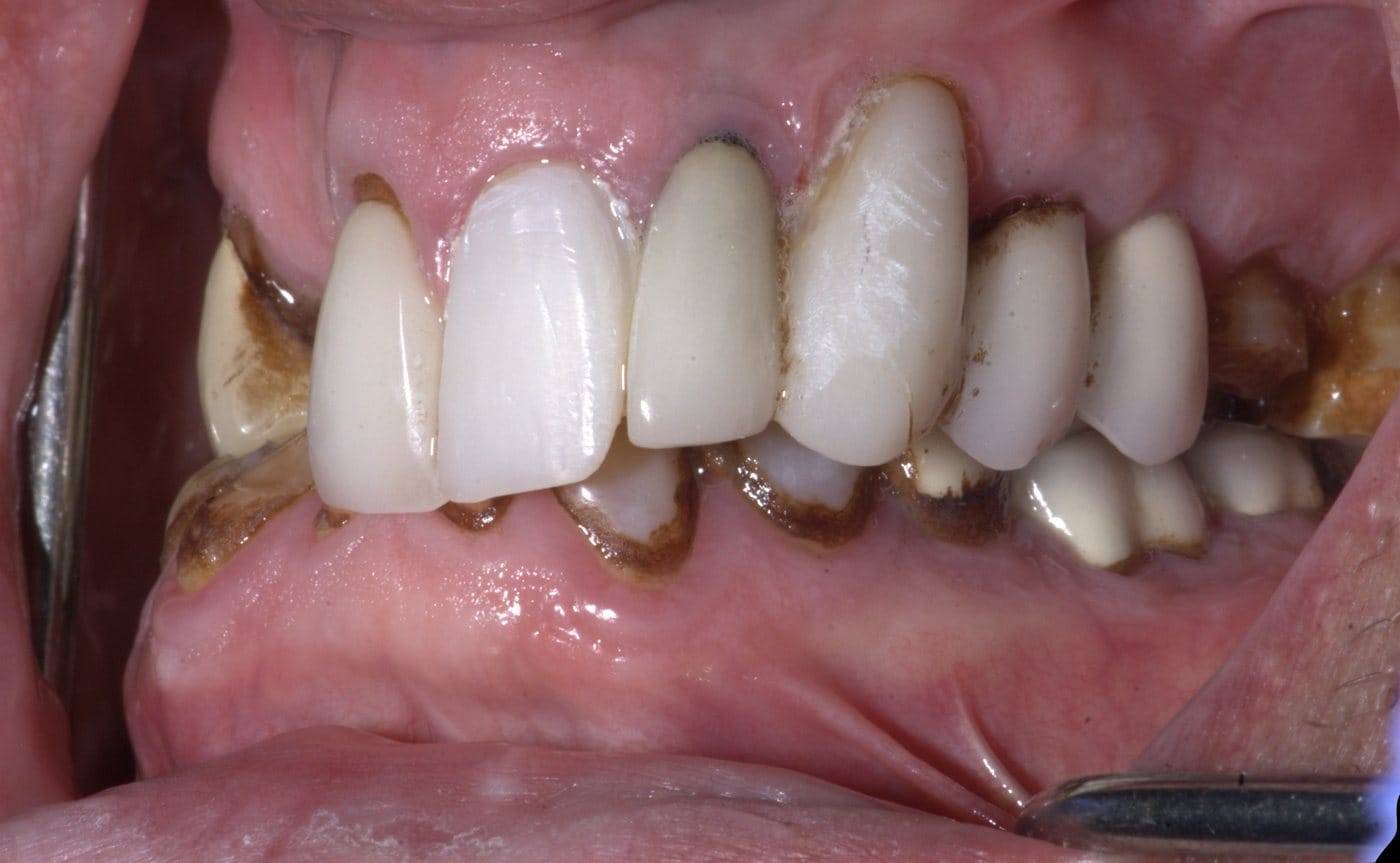
05
Rubbing on the wrong side
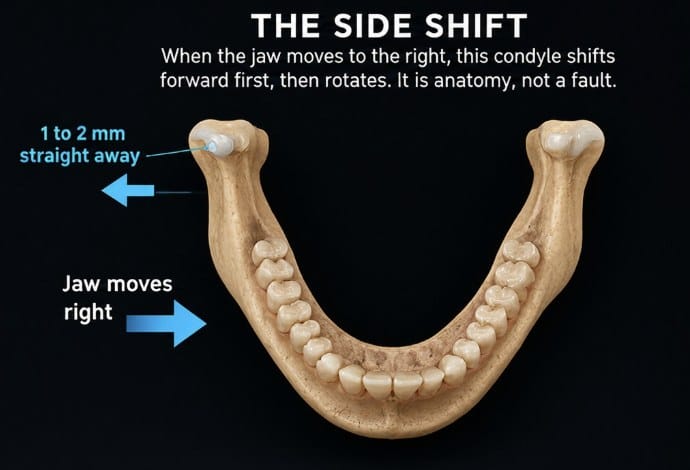
06
A sideways shift, locked
The seventh is the one that brings most of these patients to me: a reconstruction that built several of the above into the mouth at once.
00 / First, honesty
The bite is not the cause of most jaw pain. It is the cause of some.
What the evidence says
For decades dentists blamed almost every jaw joint problem on the bite and ground teeth to fix it. The research of the last twenty years has corrected that. Most temporomandibular disorders are driven by muscle tension, clenching and grinding, stress, sleep, and the joint's own wear and tear, and for those patients adjusting the teeth does nothing.
But the same research did not clear the bite entirely. When the large studies looked at which features of the bite were actually more common in joint patients than in healthy people, a short list kept coming back, and it is a list of things that stop the jaw from closing to a stable, seated position.
Bite features that are more common in jaw joint patients than in healthy people
From the multifactorial studies of Pullinger and Seligman (1993, 2000) and the reviews that followed. Each one is a reason the jaw cannot find a stable stop.
- A long slide
- When the jaw first touches a tooth and then has to slide more than about 2 mm to bite fully. The first tooth deflects the jaw, and the joint follows it, every single time.
- Missing back teeth
- Five or more missing back teeth, without replacement. The joint and the front teeth are left to carry the bite.
- Front teeth that don't meet
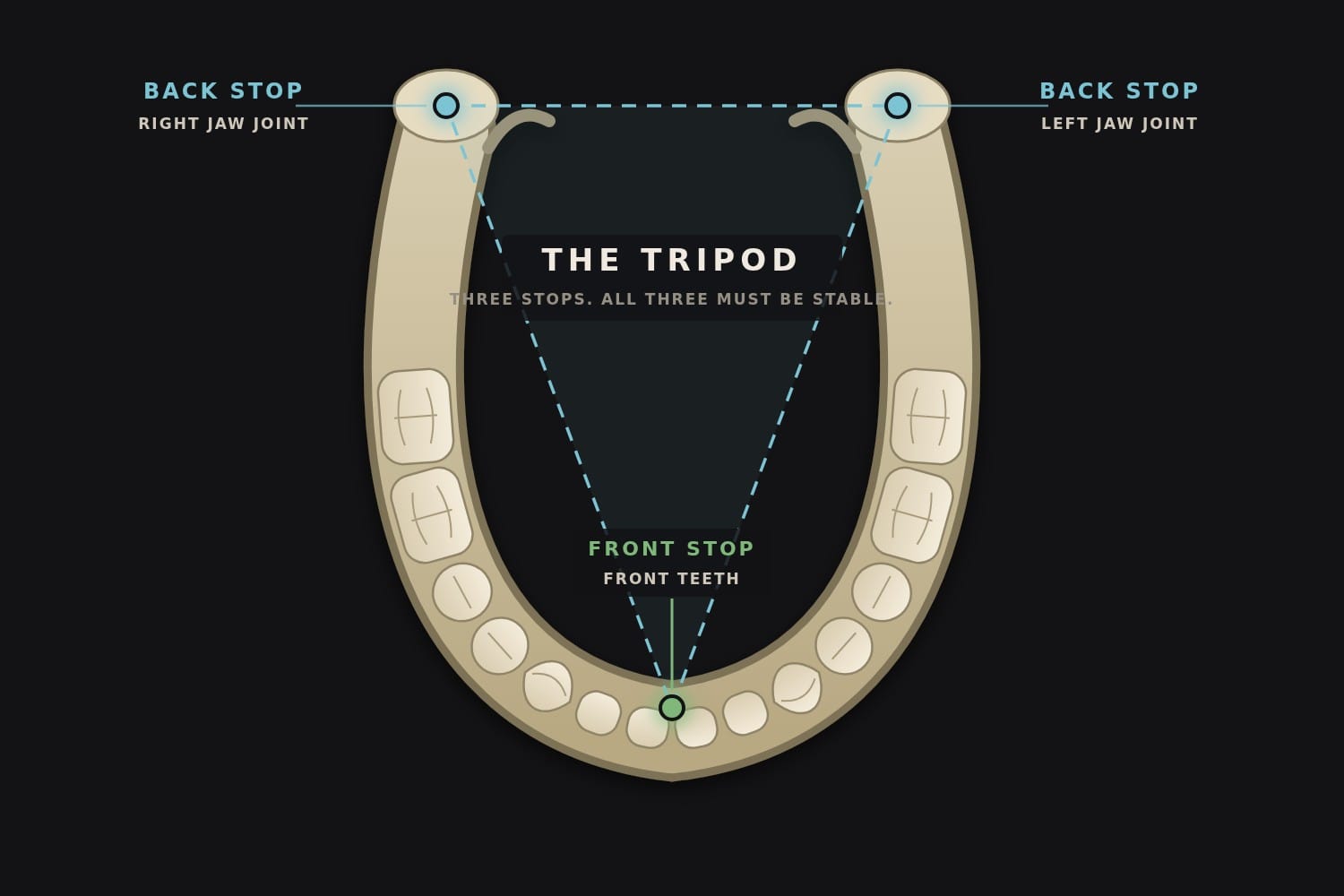
- An open bite at the front, or an overjet of more than about 6 mm. The front stop of the tripod is missing, so the joints take what the front teeth should.
- A crossbite on one side
- The jaw is pushed to one side to close, and one joint is loaded differently from the other.
- A sudden change
- An experiment in Finland placed a small high spot on a tooth in volunteers. Healthy people adapted within days. People who had had joint trouble before developed pain and tenderness (Le Bell, 2002). A new crown or bridge that is high is this experiment, done by accident.
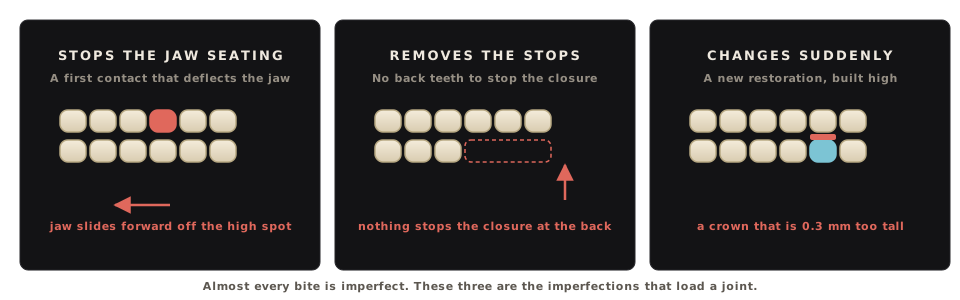
Put those together and a pattern appears. The bite does not cause joint trouble by being imperfect. Almost everyone's bite is imperfect. It causes trouble when it stops the jaw from seating, when it removes the stops the joint relies on, or when it changes suddenly in someone whose joints and muscles are already on the edge. Those three are the subject of this segment, and all three are things a dentist can create, and a prosthodontist can prevent.
01 / The seated joint
What a jaw joint needs from the teeth
Centric relation
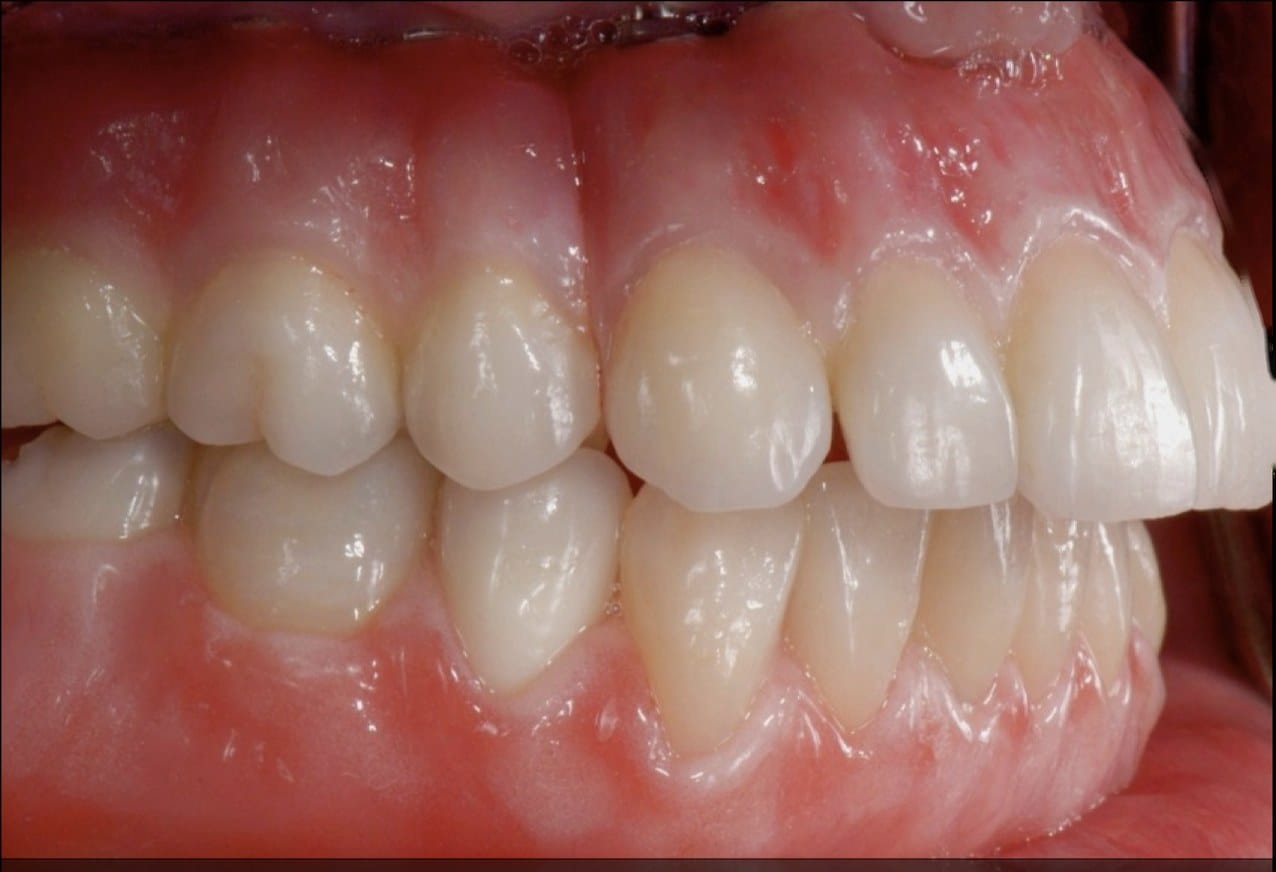
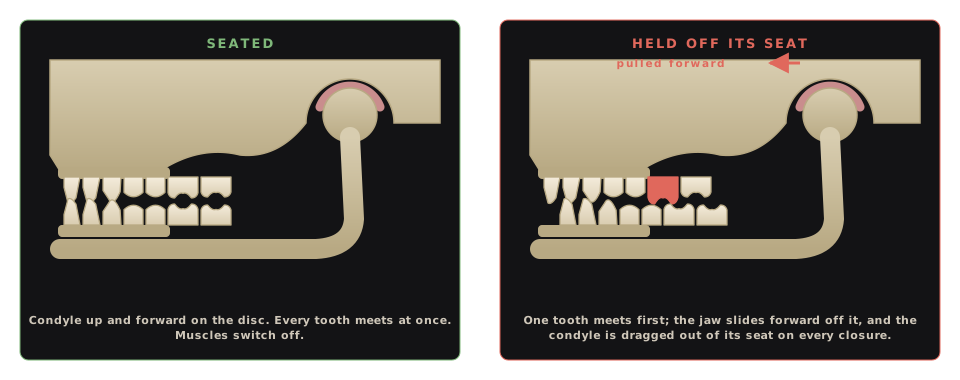
Each jaw joint is a ball in a socket with a cartilage disc between them. When the jaw muscles are relaxed, the ball sits up and forward in the socket, resting on the disc, braced by the ligaments. That is its seated position, and it is the starting point for every reconstruction I plan. In that position the joint is loaded straight through bone and disc, the way it was designed to be, and the muscles can switch off.
The problem is that the joints do not decide where the jaw closes. The teeth do. If the first tooth to touch is somewhere other than where the jaw sits when the joints are seated, the jaw has two choices: stop there with the joints held off their seat, or slide to a full bite with the muscles dragging the joints along. Either way, the muscles cannot rest, and the joint is loaded obliquely instead of straight up.
One more thing I am careful about. A joint that has already been damaged, with a disc that has slipped forward or a condyle that has remodeled, may no longer be able to reach the textbook seated position. It can still be given a stable, comfortable position of its own, an adapted seated position, and the bite is then built to that. The principle does not change: find where this joint can rest, then make the teeth meet there.
The rest of this segment is simply a list of the ways teeth can take that resting position away.
01b / Muscle or joint?
Most "TMJ pain" is muscle pain, and muscles answer to the bite
Occluso-muscle pain
The first question I ask of every jaw patient: is the pain coming from the joint itself, or from the muscles that move it? They feel similar. They are treated completely differently.
A joint that is structurally damaged, a displaced disc, a worn or flattened condyle, hurts when it is loaded. A muscle that is overworked hurts when it is used and is tender to touch, but the joint underneath it is fine. When the muscles are the source, the bite is very often the reason: a muscle that has to brace the jaw off a high tooth, or pull it forward past a fence, or hold it in a long slide, never gets to rest, and a muscle that never rests becomes painful. I call this occluso-muscle pain, and it is the kind of jaw pain that the bite can cause and that correcting the bite can relieve.
The load test
- The jaw is gently guided to its seated position with the muscles relaxed, and the joints are loaded lightly through the chin
- A healthy, seated joint can take that load without any discomfort
- Tenderness or tension on loading means either the joint is damaged, or a muscle is refusing to let it seat because a tooth is in the way
- Which of the two is then told apart by deprogramming the muscles and testing again
Deprogramming
- A small flat platform is placed behind the upper front teeth so that no back tooth can touch
- Within minutes to hours the muscles stop steering around the interferences they have learned, and the jaw returns to where the joints seat
- If the joint now loads comfortably and the first tooth to touch is a different one, the bite was holding the jaw off its seat
- If the joint still hurts on loading with the muscles switched off, the joint itself is the problem and the bite is not the answer

This is why I do not go straight to adjusting teeth. Two minutes with a deprogrammer tells me whether the muscles are the source and whether the bite is driving them. It is also why a well-made splint relieves so many patients: it gives the muscles a flat, stable surface with no interferences to fight, and they stand down.
02 / The high spot
A tooth that hits first
Deflective contact
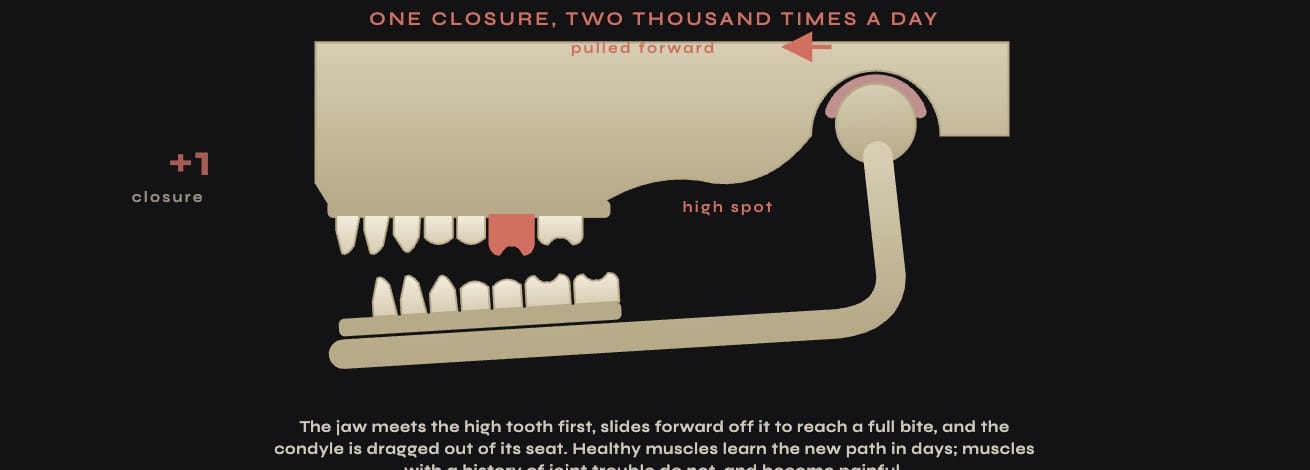
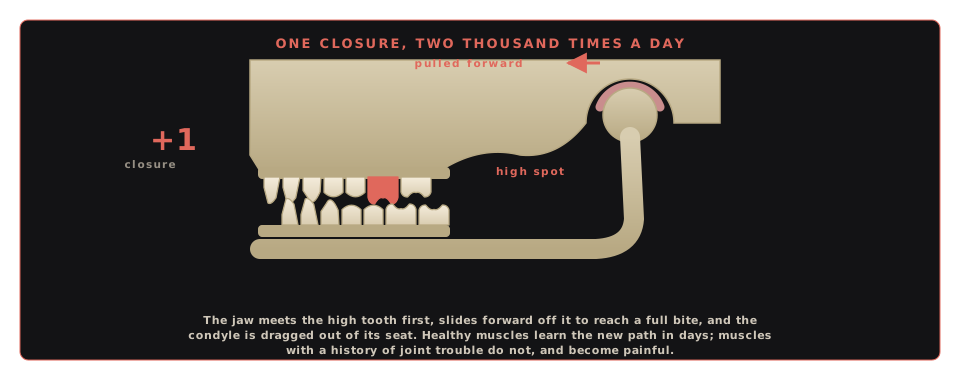
The simplest case. One tooth, or one filling, or one new crown, is a fraction of a millimeter too tall. Every time you close, it touches first, and the jaw has to slide off it to bring the other teeth together. You swallow around two thousand times a day, and each one is a small deflection of both joints and a small burst of muscle activity to steer around the obstacle.
Most people's muscles adapt to a small interference within days; the jaw learns the new path. That is what the Finnish experiment showed in healthy volunteers. But in the same experiment, people with a history of joint trouble did not adapt. They got sore. If you are in that group and your dentist fits a crown that is slightly high, the jaw ache and the tender muscles that follow are not a coincidence. This is the most common reason a patient arrives in my office with a new restoration and a new jaw problem.
How it loads the joint
- The jaw closes, meets the high tooth, and is deflected forward or sideways to reach a full bite
- The muscles on one side fire to steer the jaw; they never fully relax
- One condyle is pulled off its seat with every closure, thousands of times a day
- In a susceptible patient, muscle pain first, then joint noise or pain
How it is found and fixed
- Marking paper and a thin foil shim show where the teeth touch first
- The jaw is guided to its seated position and the first contact is compared with the full bite
- A single high restoration is adjusted. That is a diagnosis, not a treatment for jaw pain in general
- If the slide is long and involves many teeth, the answer is planning, not grinding
03 / No back stops
When the back teeth no longer stop the jaw
Posterior support
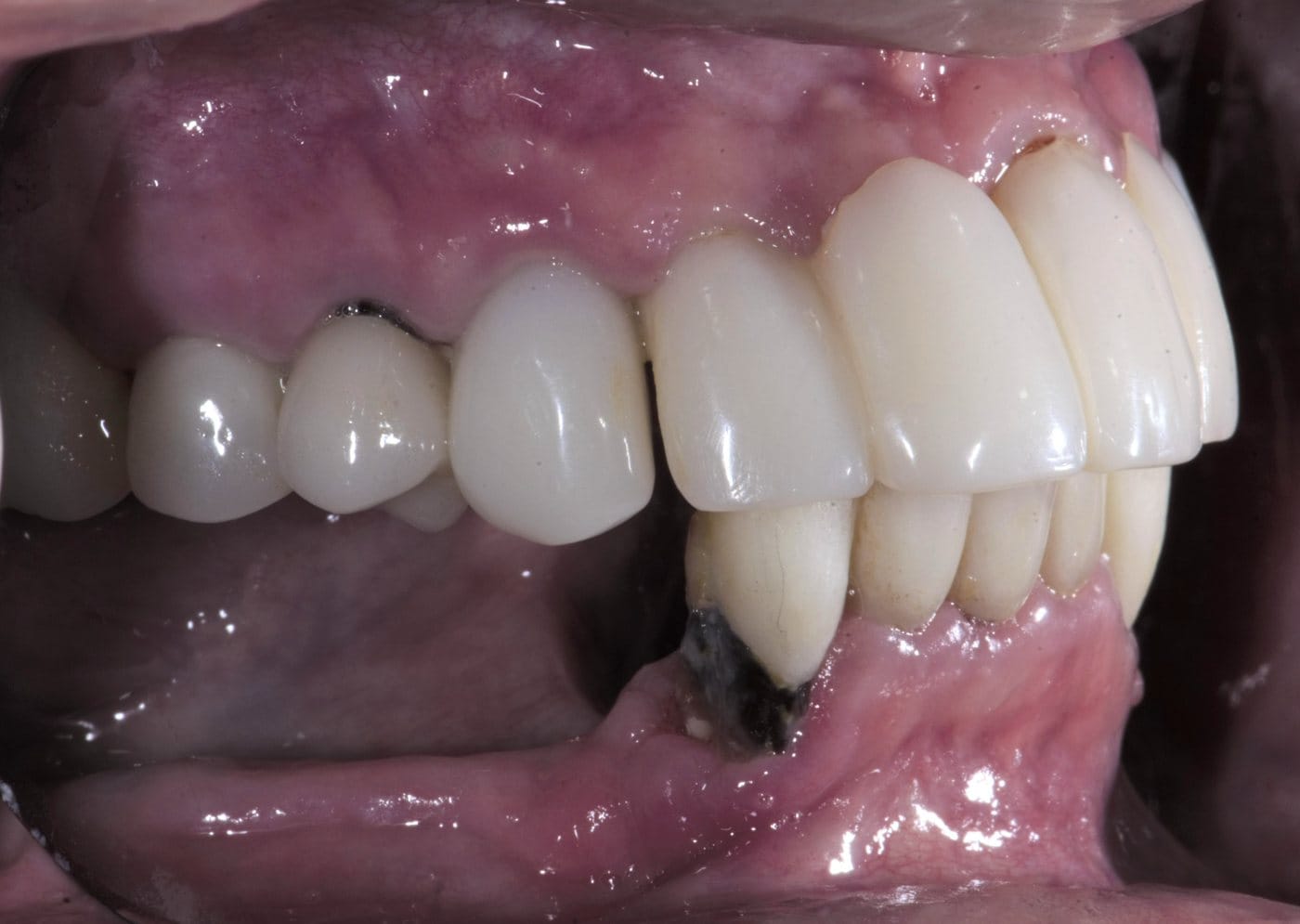
The back teeth are the jaw's stops. When they meet properly, the force of closing goes straight down through them and the joint carries only its share. When they are missing, worn flat, or restored so that they never actually meet, the jaw keeps closing until something else stops it, and that something is the joint itself and the front teeth.
Back support rarely disappears all at once. It goes in stages, and at every stage the front teeth and the joints take over a little more of the work they were never built for. Seeing the sequence is the easiest way to understand why this is on the list.
- It starts with a segment. When one larger section of back teeth is lost or worn away, the stops on that side are gone. The jaw closes further than it should, the front teeth start to carry load they were designed only to guide, and they begin to tip, wear and chip. At this stage the face still looks normal and the patient may feel nothing but a tired jaw.
- Then the bite collapses. As more back segments go, nothing holds the jaw at its proper height. The front teeth are driven together, flare and wear, the lower face shortens, the lips fold in, and the muscles and joints are working at an angle they cannot sustain. The condyle is driven up and back into the socket, compressing the disc and the tissue behind it. Over years this is one of the routes to a displaced disc and a worn joint surface.
- And the badly restored case is no better. Sometimes the back teeth are not missing at all. They have been replaced with implants, but restored at the wrong height, too short to meet the opposing teeth, so they do not support the bite. The jaw behaves as if the back teeth were still gone. A reconstruction with no stops is a collapse built in ceramic.
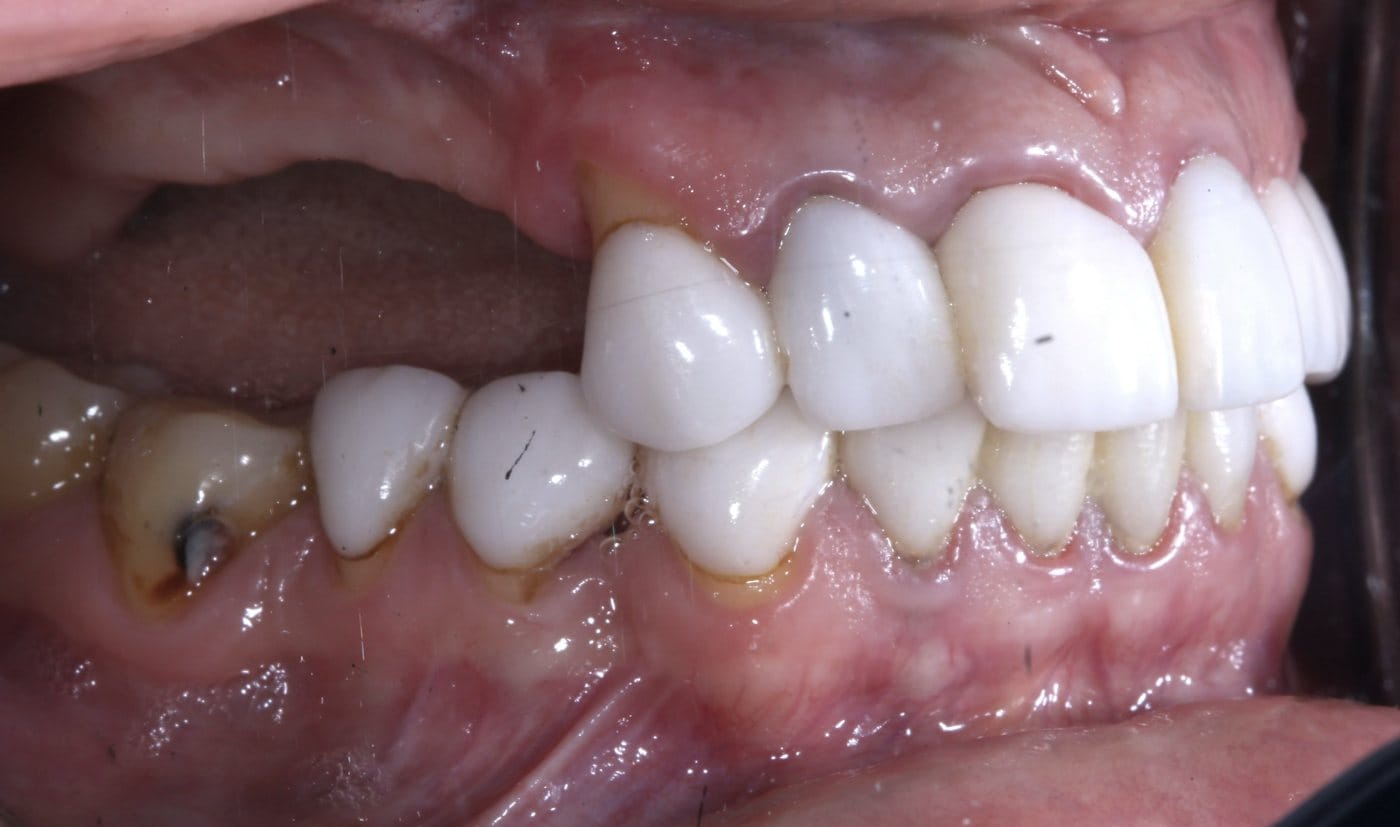
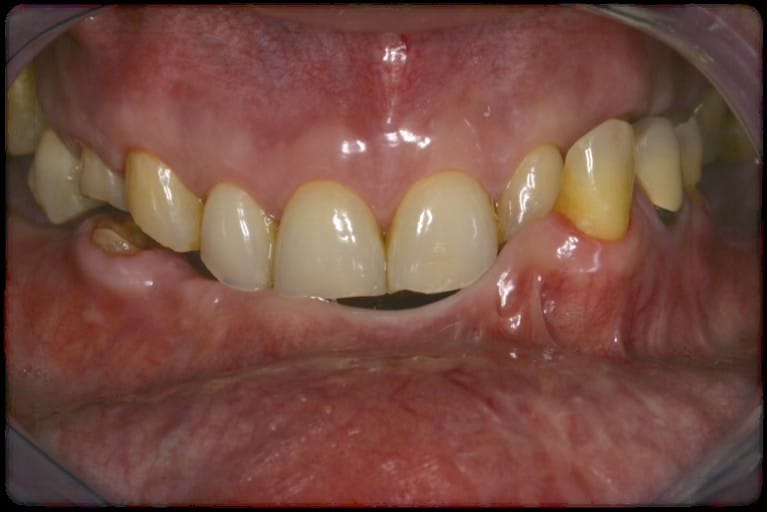
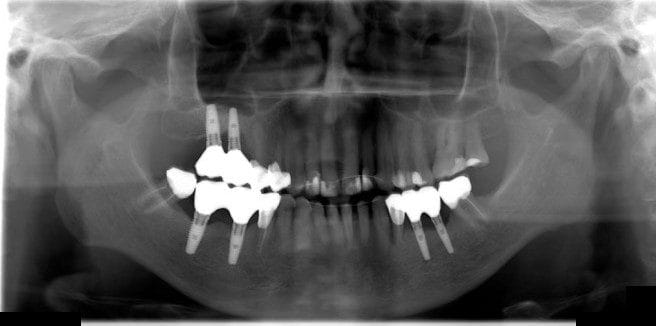
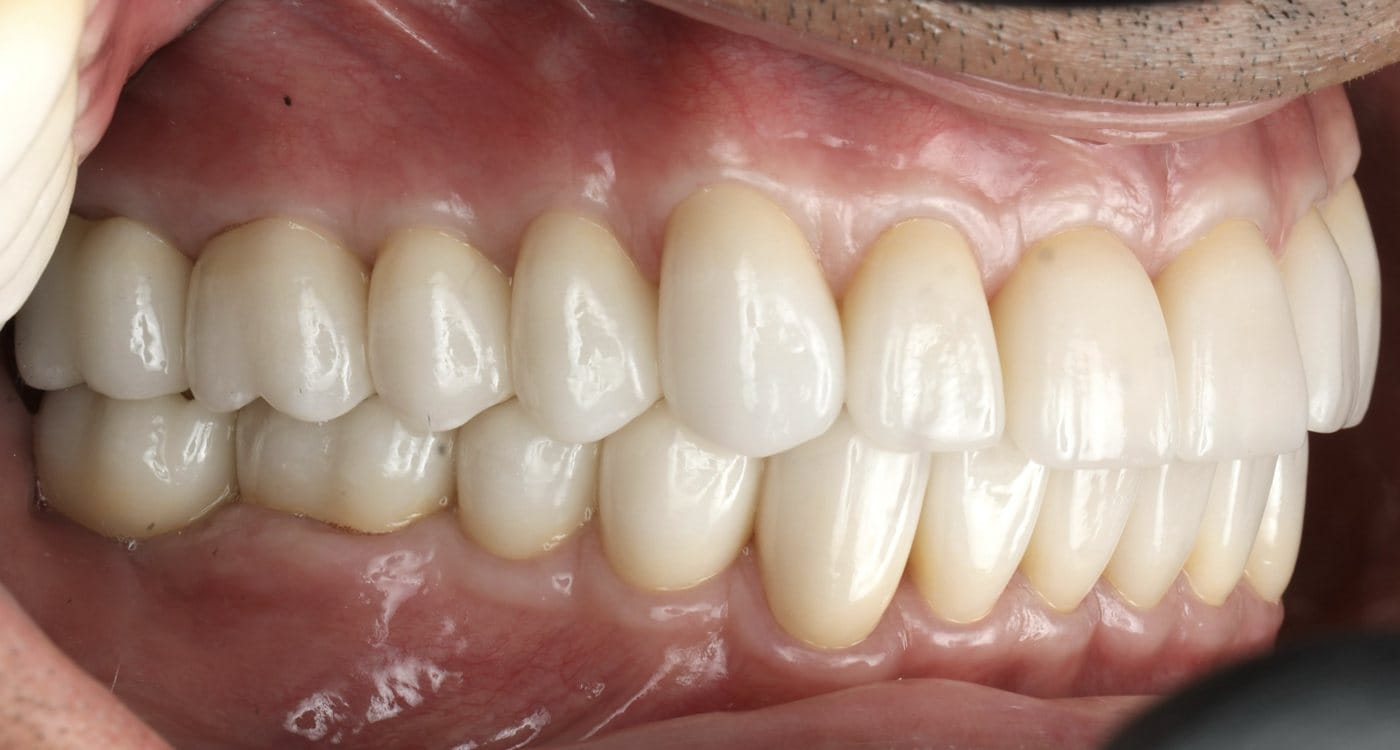
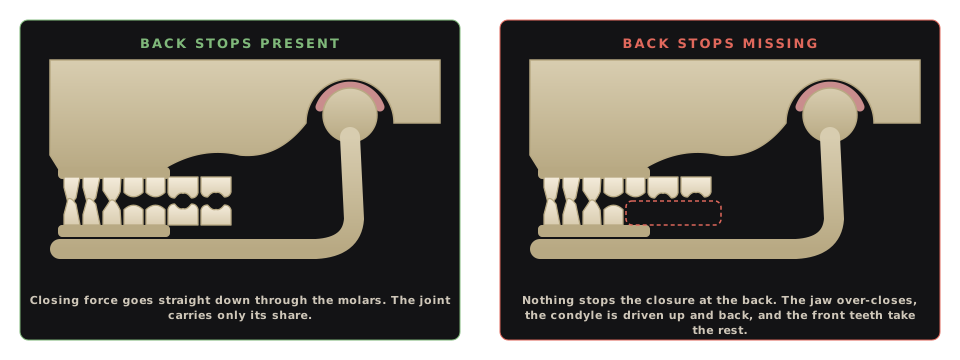
A reconstruction that leaves the back teeth short of contact, or that puts them on overhangs with nothing beneath, has removed the stops. The joint pays for it long before the screws do.
04 / Bite height
Too closed, or opened too far
Vertical dimension
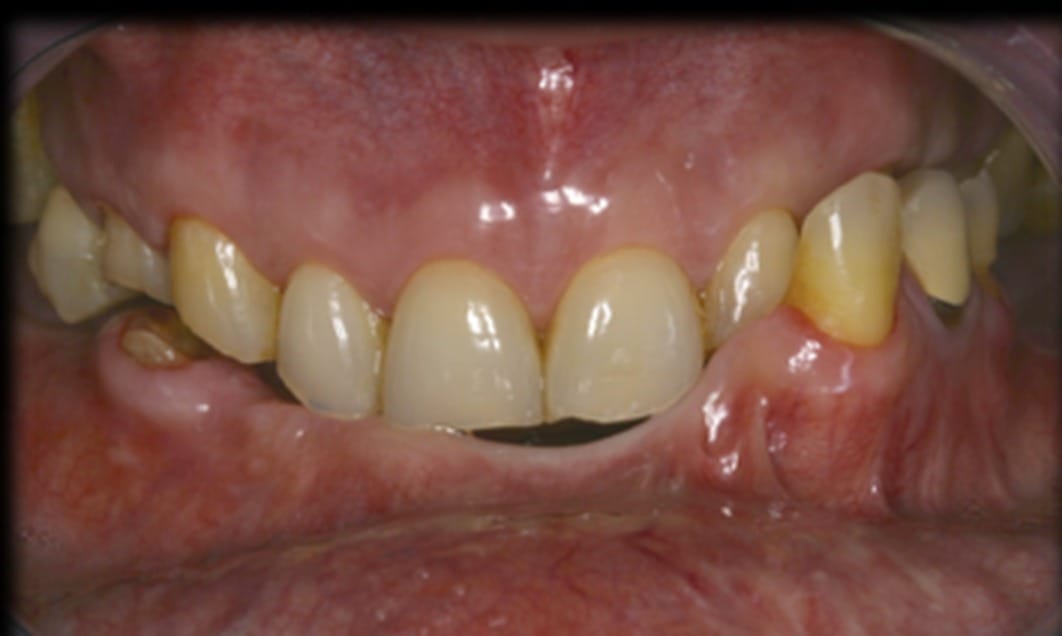
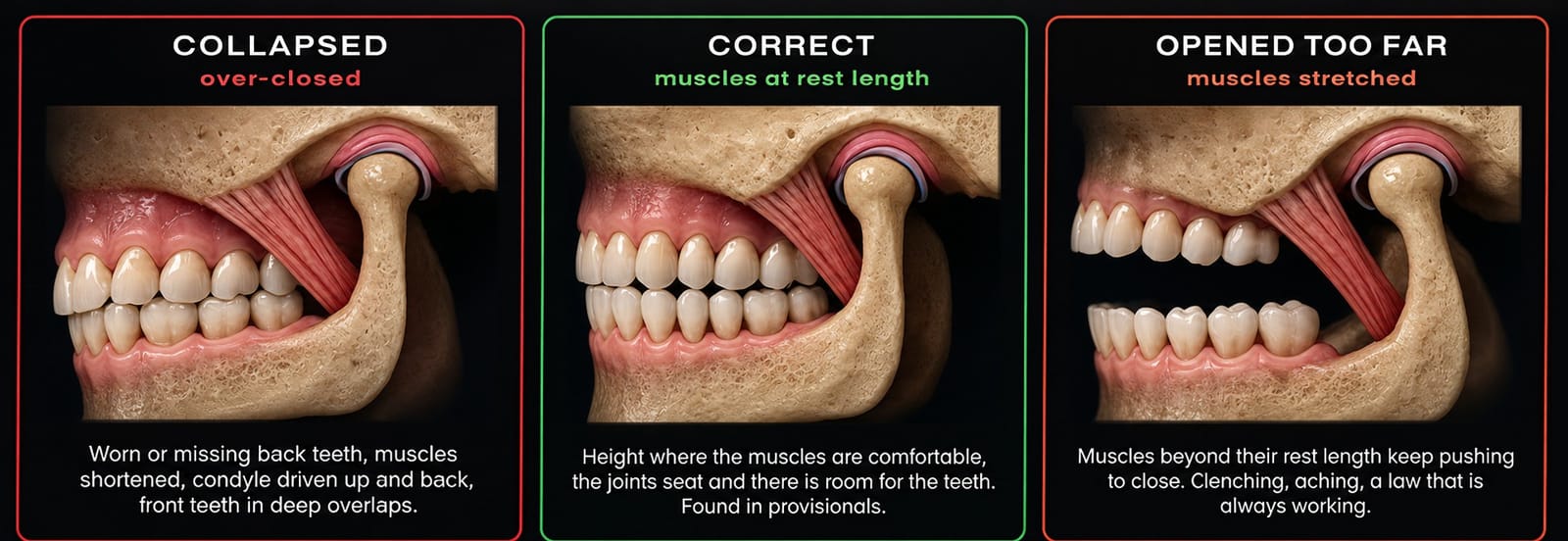
The height of your bite, how far apart your jaws sit when the teeth are together, is set by the teeth. Worn or collapsed bites close it down; a reconstruction can open it. Either direction, taken too far, loads the joint.
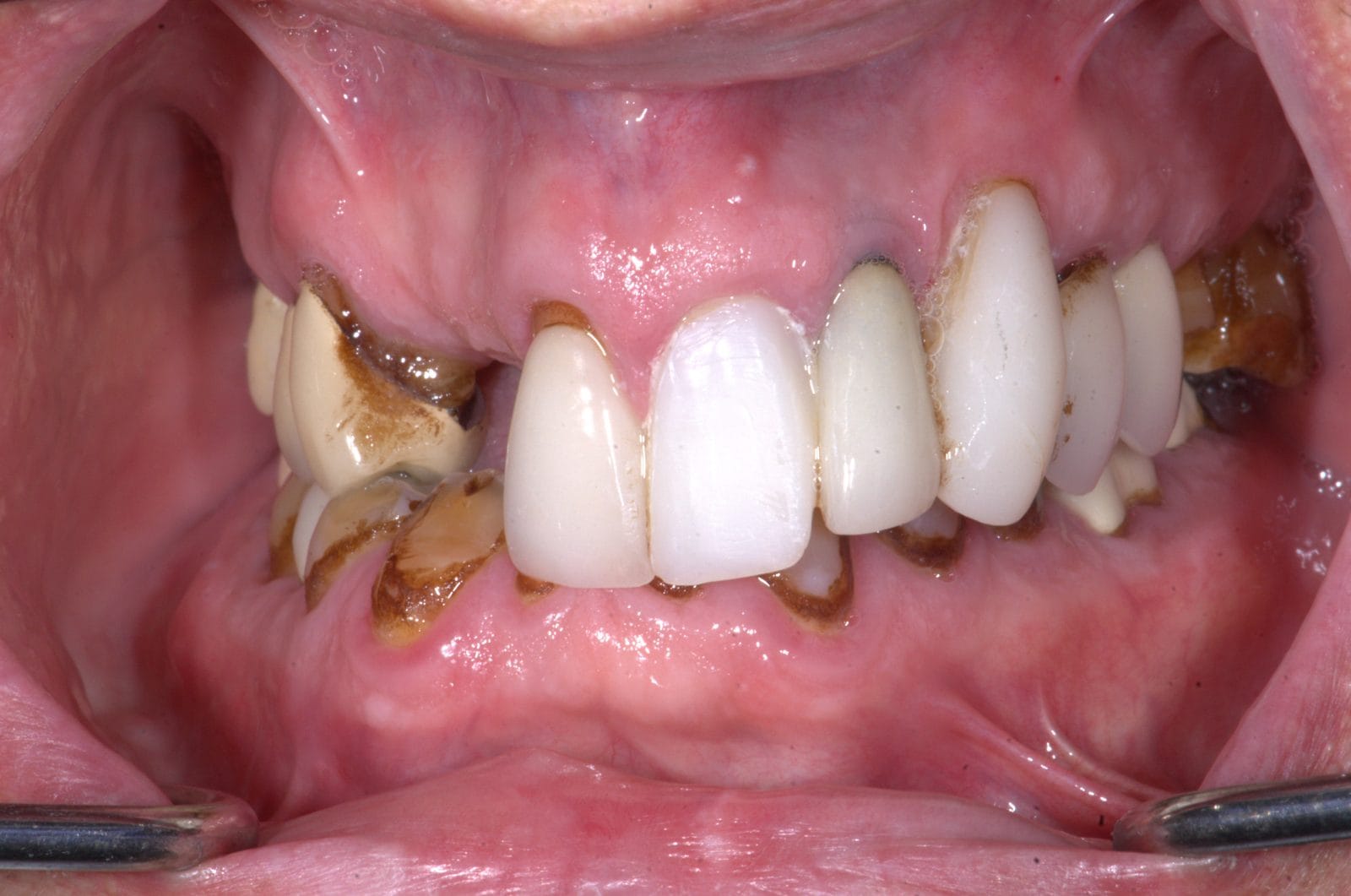
When the bite collapses, as it does after years of wear or lost molars, the jaw over-closes. The condyle is driven up and back, the chin comes forward, the front teeth overlap more deeply and the muscles shorten. It is the pattern I see most often in heavily worn mouths, and the joint symptoms usually arrive before the patient notices the teeth.
Why this matters is worth knowing. The height of your bite is not really set by the teeth; it is set by the length the jaw-closing muscles return to, over and over, every time you swallow. The teeth simply grow or wear to meet at that length. Change the teeth without respecting that length and the muscles do not adapt to the teeth; they go on trying to return to their own length, and the teeth, the joints or the restorations absorb the difference.
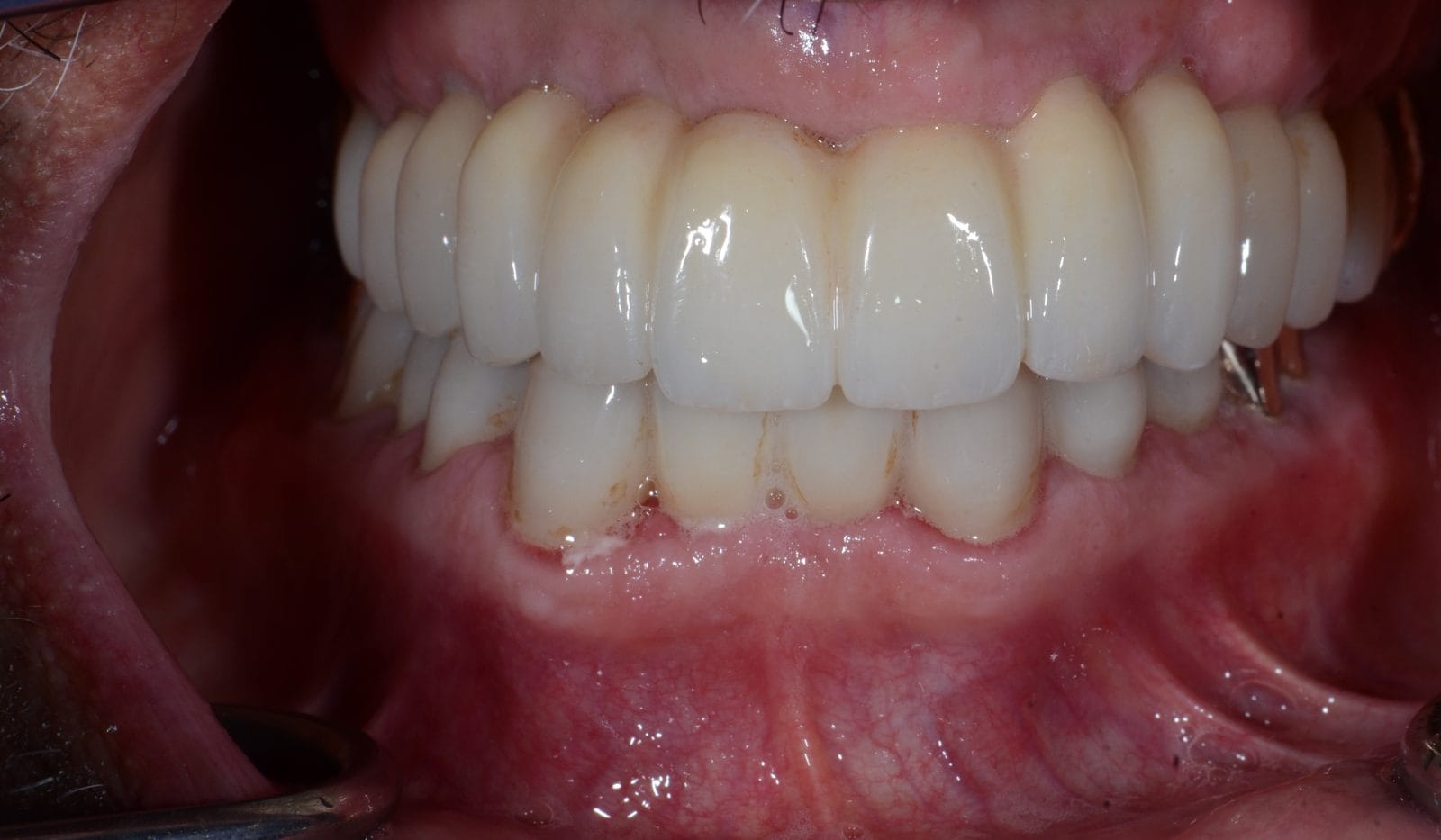
When a bite is opened too far by a reconstruction, the muscles are stretched beyond the length at which they can rest. The patient clenches to try to find a stop, the muscles ache within weeks, and the joint is loaded by a jaw that is always pushing to close. The right height is the one at which the muscles are comfortable, the joints are seated, and there is just enough room for the teeth. It is found in provisional teeth over weeks, not guessed on a model.
05 / Locked in
Front teeth that cage the jaw
Steep or fenced guidance
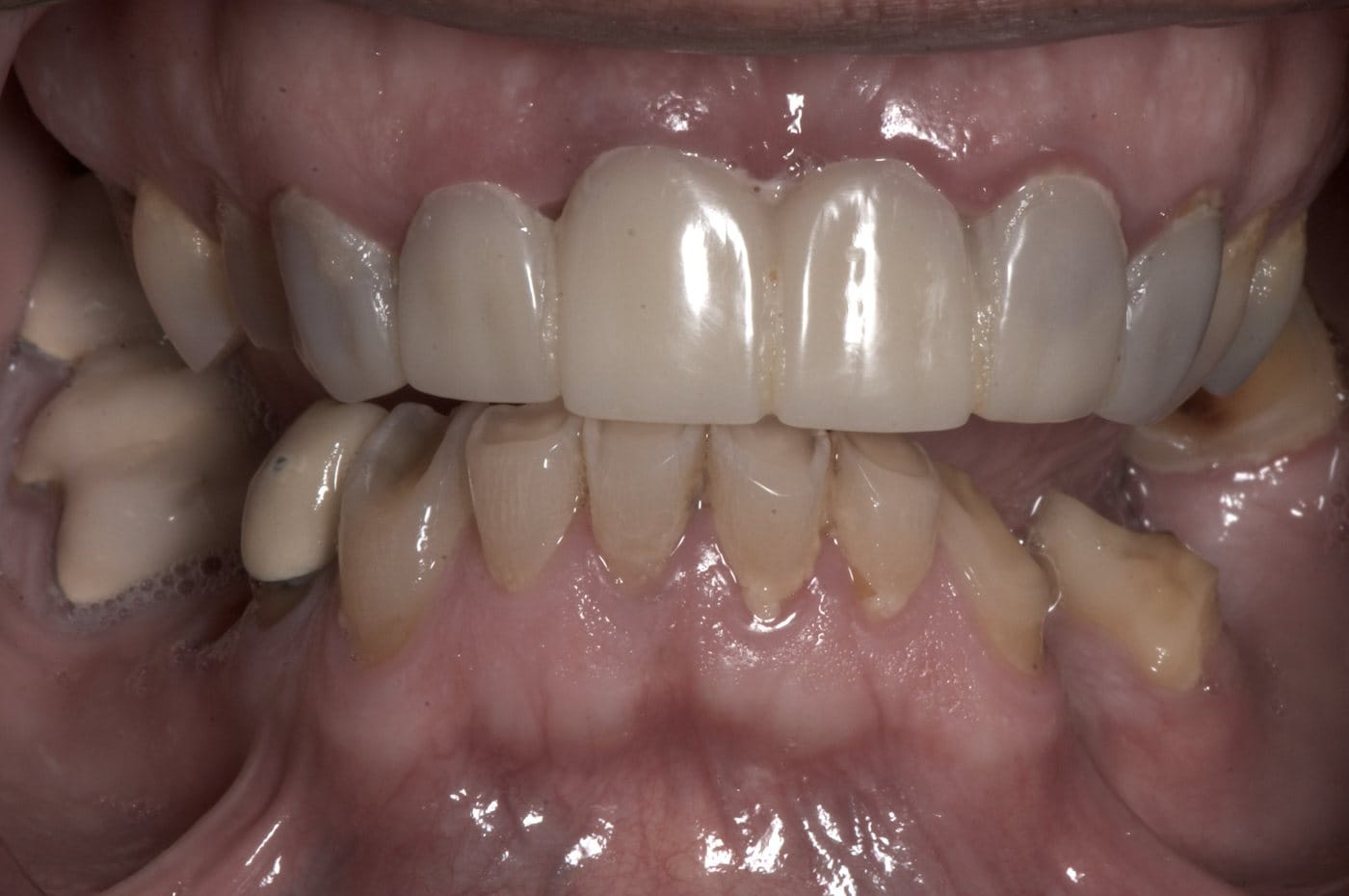
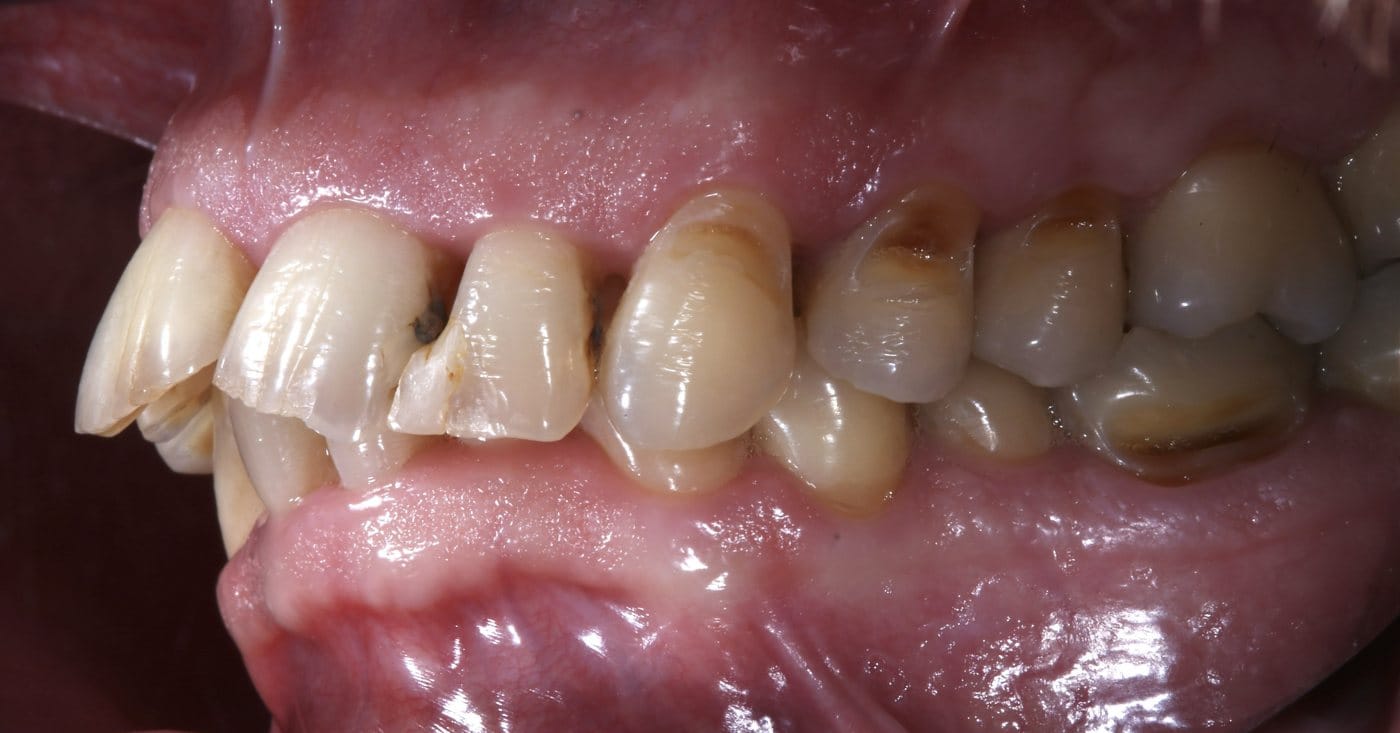
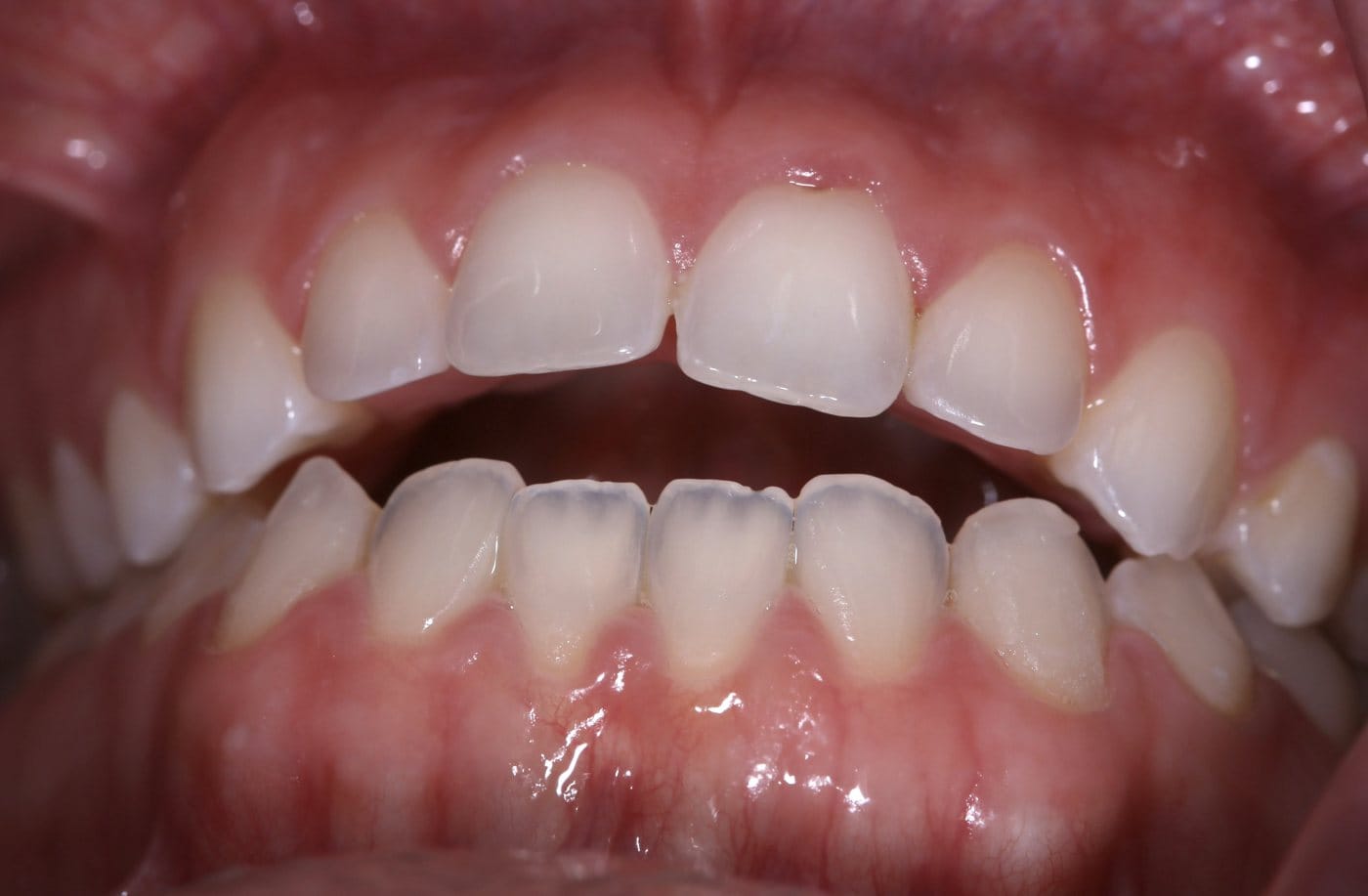
The front teeth guide the jaw as it moves. When the slope between the upper and lower front teeth is steep, every forward or sideways movement of the jaw is a climb, and the muscles work hard against the teeth to make it. When the upper front teeth overlap the lowers deeply with no room in front, the fenced bite, the jaw cannot move forward at all without hitting something. It is caged. The only way out is down and back, straight into the joint.
Patients with a fenced bite often have a particular pattern: worn backs on the upper front teeth, worn fronts on the lowers, tight jaw muscles in the morning, and joints that click or ache. Electromyography confirms what they feel: flattening the guidance drops the muscle activity (Williamson and Lundquist, 1983). A reconstruction that builds steep guidance in, usually by making the front teeth longer for looks without opening the fence, creates the problem from scratch.
The upper front teeth hang far down over the lowers. Every sideways or forward slide is a climb up a steep slope.
The lower front teeth sit tucked behind the uppers with no room in front. The jaw cannot go forward; its only way out is back into the joint.
The front teeth do not lock together. Nothing blocks the jaw, so it can leave its seat freely and the back teeth separate.
06 / Rubbing on the wrong side
Back teeth that drag during a chew
Working and non-working interferences
When you chew on your right, the jaw swings to the right. On the chewing side the teeth should glide and then separate; on the opposite side, the one you are not chewing on, the back teeth should separate completely the moment the jaw moves. If a back cusp on that opposite side catches, the jaw is levered: the chewing side pivots on a tooth that should not be touching, and the condyle on the non-chewing side is pulled down and across its socket.
These non-working interferences are the most damaging contact in the mouth, because they load the joint on the side that is moving, through a lever, with the full force of the chewing muscles behind it. They are also the easiest to build into a reconstruction by mistake: a molar cusp made a little too tall, a bite set up only in the closed position and never checked in movement.
Working-side rubbing
- Back teeth on the chewing side keep touching instead of handing over to the canine
- Wears the cusps flat, splays the teeth, overloads implants on that side
- Muscles on that side stay recruited through the whole chew
Non-working-side rubbing
- A back cusp on the opposite side catches as the jaw swings
- The jaw pivots on it; the moving condyle is dragged across its socket
- Classic cause of a clicking, aching joint on one side, and of fractured cusps and loose implant screws
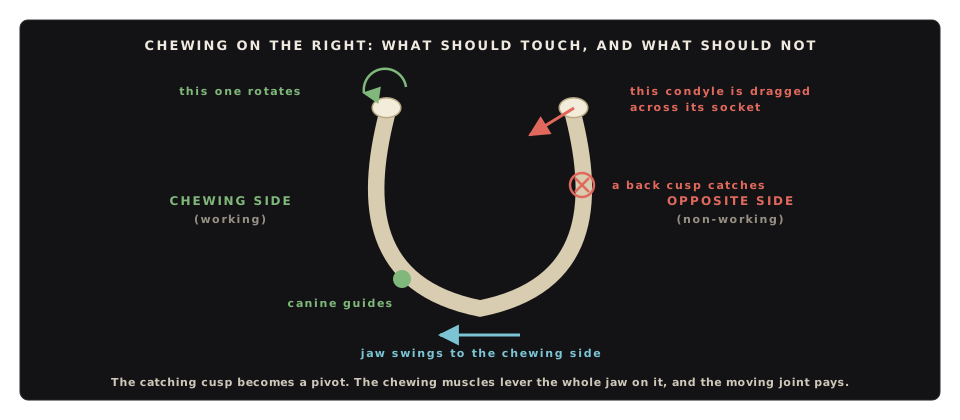
In a properly engineered bite the canine, or a group of front teeth, lifts the back teeth apart the instant the jaw moves, on both sides. Nothing at the back touches in any direction. That is checked with colored marking paper in every direction of movement, in the provisional teeth first and again in the final ones.
07 / The locked shift
A sideways shift, trapped by steep cusps
Immediate side shift
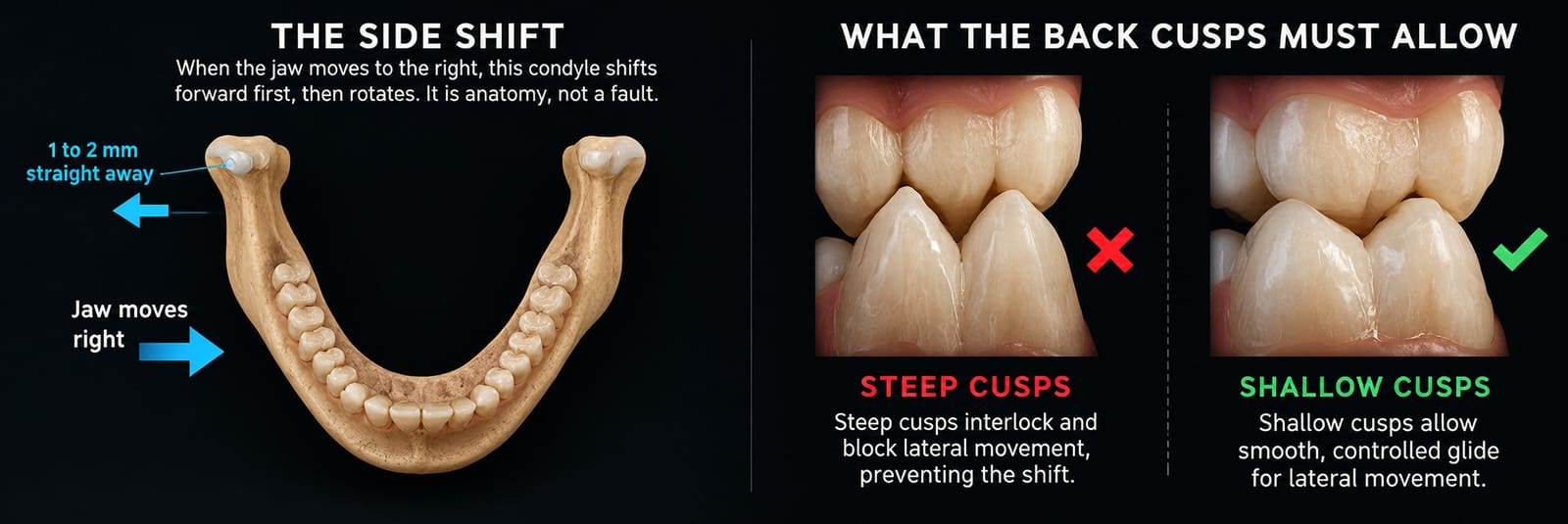
Here is the one almost no one checks. When some people move their jaw to the side, the joint on the side they are moving towards does not just rotate; it shifts bodily outward first, by a millimeter or two, before it starts to rotate. This is the Bennett movement, and when the shift happens straight away it is called an immediate side shift. It is a feature of the person's joint anatomy. It is not a disease, and it cannot be changed.
What matters is whether the teeth allow it. A jaw with an immediate side shift needs shallow, broad back cusps so the teeth can slide apart as the condyle shifts. If a reconstruction gives that patient steep, tall back cusps, the shift is physically blocked: the condyle tries to move outward and the cusps lock it. Now every sideways chewing stroke is a fight between the ligaments of the joint and the ceramic of the teeth. The joint loses. This is one of the routes to a damaged disc, to chronic pain on one side, and to ceramic that fractures for no apparent reason.
The diagnosis is made before the teeth are designed, by recording how the patient's own jaw moves, on an articulator that can reproduce the shift or by digital jaw tracking. If the shift is there, the cusp heights and the slopes of the back teeth are set to let it through. It takes a few extra minutes and prevents a problem that cannot be fixed by polishing afterwards.
08 / The reconstruction
When one treatment builds in all of them
Iatrogenic TMD
A full-mouth reconstruction is the one dental treatment that can create every problem in this segment at once, because it replaces the whole bite in one go. It can also prevent every one of them, which is why the bite is engineered first and the teeth are made to fit it.
The cases I see with joint pain after a reconstruction share a short list of errors: back teeth left short of contact or placed on overhangs, so there are no stops; a bite opened to make room for ceramic without checking the muscles could live there; front teeth lengthened for appearance and the guidance made steep or fenced in the process; back cusps copied from a tooth library rather than from the patient's own movement, so they interfere on the non-working side or lock a side shift. Each one on its own may be tolerated. Together, in a patient whose joints were already vulnerable, they are a reliable way to produce a jaw that never rests.
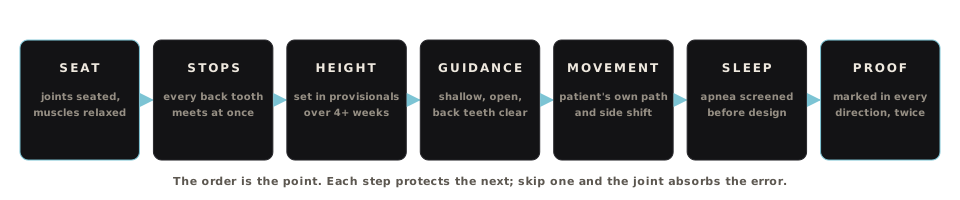
- Seat
- The bite is built to the seated joint position, recorded with the muscles relaxed, not to wherever the old teeth happened to meet.
- Stops
- Every back tooth meets its partner at the moment the joints seat. No overhangs, no teeth short of contact.
- Height
- Set in provisional teeth over at least four weeks, at the height where the muscles are comfortable and the joints seat.
- Guidance
- Front teeth shallow enough to let the jaw leave its seat; the fence opened; the back teeth separate in every direction.
- Movement
- The patient's own side shift and jaw path recorded and reproduced in the cusp shapes, not taken from a library.
- Sleep
- Screened for sleep apnea before the bite is designed; referred for a sleep study if positive, so the night-time forces are known and managed.
- Proof
- Marking paper in every direction, in the provisionals and again in the final teeth. The joint is examined at every stage.
08b / The standard
Five requirements for a stable bite
What every reconstruction is checked against
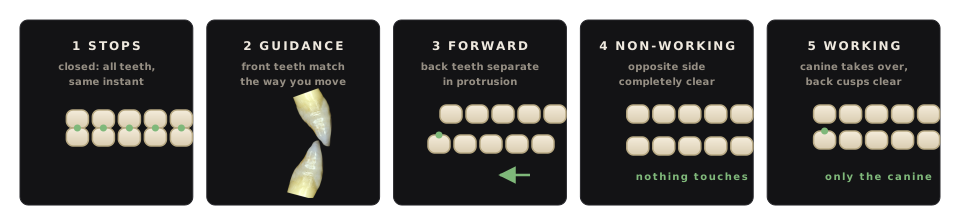
A stable, joint-friendly bite comes down to five conditions. Every one of the problems in this segment is a failure of one of them, and every reconstruction I deliver is checked against all five before it leaves the provisional stage.
- 1
Stable stops on every tooth when the joints are seated. Both condyles in their seated position and the teeth meeting at the same instant, with equal force, all the way round. No slide, no high spot, no tooth short of contact.
- 2
Front teeth that guide in harmony with the way you move. The slope of the front teeth matches the patient's natural envelope of movement: shallow enough to let the jaw out, not so flat that the back teeth stay in contact.
- 3
Back teeth separate when the jaw comes forward. The moment the lower front teeth begin to slide on the uppers, every back tooth is clear.
- 4
Back teeth separate on the side you are not chewing on. No non-working interferences, ever. This is the contact that levers the joint.
- 5
Back teeth on the chewing side never override the front guidance. The canine or the front group takes over the instant the jaw moves sideways; the back cusps are shaped to the patient's own joint path, including any side shift, so they get out of the way.
There are also signs that tell you a bite has failed these tests before the joint ever complains: teeth that are sore to bite on, teeth that have become loose or have drifted, unexplained wear, notches at the gum line, a vibration you can feel in the front teeth when you tap together, and jaw muscles that are tender in the morning. If a patient has several of these and a sore jaw, the bite is on the list of suspects whatever the X-ray of the joint shows.
08c / Sleep
Sleep apnea, grinding, and the jaw that never rests
Screen before you treat
There is one cause of jaw pain that is neither the bite nor the joint, that makes every problem in this segment worse, and that is routinely missed: the patient is not breathing properly at night.
Obstructive sleep apnea is a repeated narrowing of the airway during sleep. Each time it happens the brain rouses briefly, the jaw muscles fire, and very often the teeth clench or grind, because pushing the lower jaw forward is the body's reflex for opening the airway. A patient with untreated apnea may be doing this hundreds of times a night. The muscles never get a rest period, the joints are loaded all night, and the teeth, the restorations and the implants take the force. In the morning the jaw is tired and tender, and the patient is told they have TMJ.
The connection is not speculative. In the largest prospective study of jaw pain to date, people with signs of sleep apnea were about twice as likely to develop a new jaw disorder over the following years, and people with established chronic jaw pain were about three times as likely to have signs of apnea. Around half of patients attending sleep clinics for apnea have jaw joint or muscle symptoms, against a third of the general population. Broken sleep also lowers the body's own pain threshold, which is why these patients hurt more from the same load.
What apnea does to the bite and the joint
- Night-time clenching and grinding driven by arousals, not by the teeth
- Muscles that never go through a rest cycle: tender and tired every morning
- Flattened, worn teeth and chipped ceramic that no bite adjustment will stop
- A joint loaded for hours with the jaw clamped or thrust forward
- Lower pain threshold from fragmented sleep, so everything hurts more
Why it changes the plan
- A bite rebuilt in an undiagnosed apnea patient will be ground down again; the force is coming from the airway, not the teeth
- A night guard can quietly worsen breathing in some patients, so it is not prescribed blind
- A jaw-advancing sleep appliance can itself change the bite and load the joints if it is not monitored by someone who understands occlusion
- Treating the apnea, with CPAP or an appliance, often removes most of the "TMJ" without a single tooth being touched
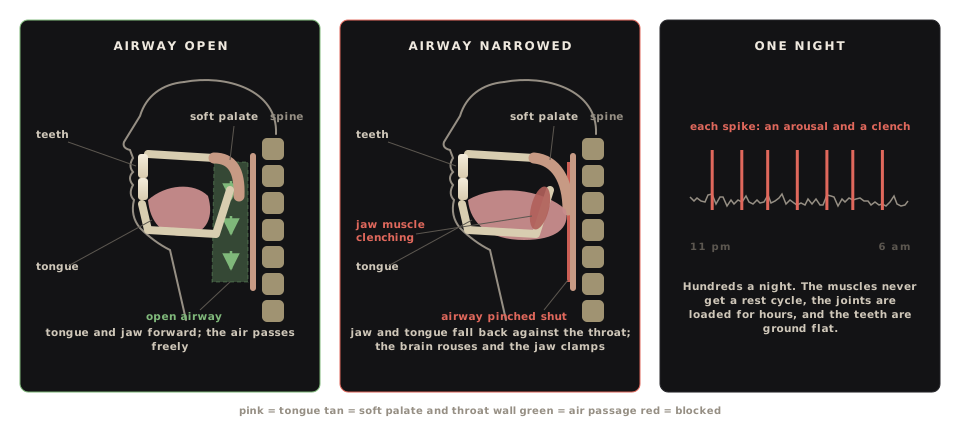
So before any bite is rebuilt in a patient with worn teeth, broken restorations, morning jaw pain or a history of fractured crowns, I screen for sleep apnea: snoring, witnessed pauses in breathing, daytime tiredness, morning headaches, a scalloped tongue, a narrow airway on the 3D scan. If the screen is positive the patient is referred for a sleep study before the reconstruction is planned, and the sleep physician and I plan together. The bite is engineered to protect the joints and the teeth from the forces that remain, and a protective appliance is designed so that it does not close the airway it is meant to coexist with.
09 / Diagnosis
Finding out whether your bite is the cause
Joint first, then the bite
Because most jaw pain is not caused by the bite, the first job is to work out whether yours is. That means examining the joint and the bite separately, and then seeing whether they point at each other. A general dentist can adjust a high filling. Working out whether a joint problem is muscular, inside the joint itself, or driven by the way the teeth meet, and what to do about it without making it worse, takes a full examination of both.
The joint itself
- Where it hurts, when it clicks, whether it locks, how far it opens and how straight
- Palpation of the joints and each jaw muscle for tenderness
- Imaging when the joint itself is in question: a 3D scan of the bone, MRI for the disc
- A history of clenching, grinding, sleep and stress, because these are the usual suspects
The bite
- The jaw guided to its seated position: does the first tooth contact match the full bite, or is there a slide?
- Marking paper in every direction: which teeth touch when the jaw moves, and which should not
- Back support: are there real stops, or is the joint doing the molars' job?
- Bite height, the slope of the front teeth, and whether the jaw is fenced in
- Jaw movement recorded, including any side shift
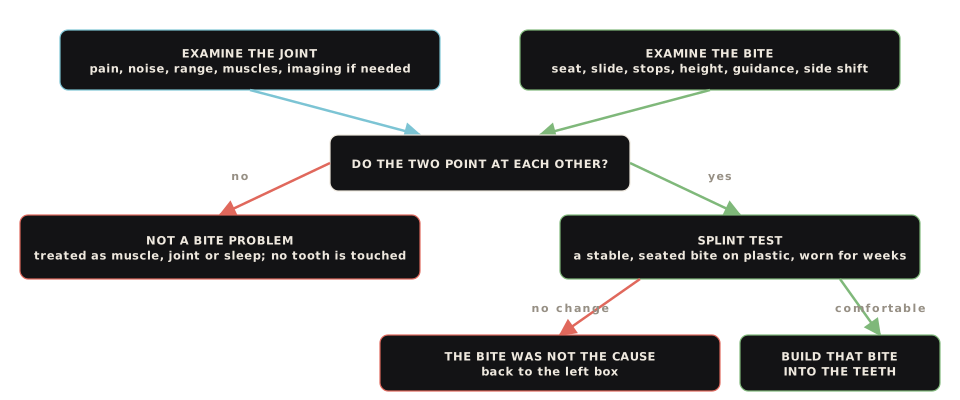
Then the two are compared. If the joint findings and the bite findings line up, if the painful side is the side with the non-working interference, if the aching muscles are the ones steering around a high crown, if the over-closed joint belongs to a collapsed bite, the bite is treated. Reversibly first: a splint that gives the jaw a stable, seated stop while the muscles settle, which also tells us whether a new bite at that position will help before anything permanent is done. If the symptoms resolve on the splint and return without it, we know. If they do not, the bite was not the cause, and we have not ground a single tooth to find that out.
In one sentence
A joint can only rest where the teeth let it.
If you have jaw pain, clicking or tired jaw muscles, especially after dental work
A first visit is an examination of the joint and the bite, and a straight answer about whether they are connected. No grinding of teeth, no commitment.
1
We examine the joint
Where it hurts, how it moves, what the muscles are doing, and whether the joint itself needs imaging. Most jaw pain is sorted out at this step without touching a tooth.
2
We examine the bite
Whether the jaw can seat, whether there are real stops at the back, how the front teeth guide, and how your own jaw moves sideways. If you have had recent dental work, this is where its effect shows.
3
We test before we treat
If the bite looks like the cause, a splint proves it reversibly before anything permanent is planned. If it is not the cause, you will be told so, and pointed to the right treatment.
This segment is educational and reflects Dr. Reshad's clinical approach. The association between specific bite features and temporomandibular disorders draws on Pullinger AG, Seligman DA, Gornbein JA, J Dent Res 1993;72:968–979 and Pullinger AG, Seligman DA, J Prosthet Dent 2000;83:66–75; the experimental interference study is Le Bell Y et al., Acta Odontol Scand 2002;60:219–222; the muscle activity and guidance data are from Williamson EH, Lundquist DO, J Prosthet Dent 1983;49:816–823. The sleep apnea figures are from the OPPERA cohort (Sanders AE et al., J Dent Res 2013;92(7 suppl):70S–77S) and Alessandri-Bonetti A et al. (2021). Reviews by Manfredini et al. (J Oral Rehabil 2012; 2017) and the 2025 scoping review in Medicina (Kaunas) are the basis for the statement that most TMD is not occlusal in origin and that occlusal adjustment is not a general treatment for TMD. Clinical photographs are from Dr. Reshad's own archive, shared with patient permission. Individual results vary. This segment does not replace an in-person evaluation.
Our Beverly Hills office at 414 N. Camden Dr., Suite 750 opens in January 2027. Until then, call (310) 444-5217 and we'll arrange your consultation.
Diagnosis before anything
Temporomandibular disorders are not one condition. Some are muscular, some inflammatory, some arise in the joint itself, some are driven by the bite, and many are a mixture. A bite altered before it is understood is very difficult to put back, so the examination comes first and it is thorough.
It covers the joints and muscles; how far and how symmetrically the jaw opens; where the teeth meet and which teeth meet first; the wear pattern on each tooth; the height of the lower face; and whether you clench or grind in your sleep, which is asked about directly and looked for in the teeth. A stable, repeatable jaw position is established and verified. Models of your teeth are mounted on an instrument that reproduces your jaw movement so the bite can be studied outside the mouth, and imaging is taken where it will change the plan.
The jaw is a tripod. It rests on three points: the two joints at the back and the front teeth. All three have to be stable at the right height. If the front teeth do not meet firmly, or a back tooth hits first and deflects the jaw, one leg of the tripod is missing and the joints and muscles carry the difference. Establishing that stable position is the first thing done, and in a collapsed bite it is often the hardest, because the muscles have learned to hold the jaw somewhere it should not be and have to be unlearned first.
The examination answers one question before any other: is the bite driving this, contributing to it, or incidental to it?
When the answer is that the bite is not the cause, you will be told so and referred to the clinician whose field it is. Orofacial pain is a recognized specialty of its own. Saying "this is not a bite problem" is part of the job, and it is said here without a treatment plan attached.
A splint is not a night guard
A pharmacy night guard, or a soft guard made in a general office, is a cushion. It absorbs grinding. It does not diagnose anything and it can make some joint problems worse.
A stabilization splint is a precisely made appliance that gives the jaw one stable, reproducible position to close into. It protects teeth and restorations from clenching and grinding, and it is diagnostic: a corrected bite position can be tested and adjusted over weeks, in your own mouth, before a single tooth is touched. If symptoms settle on the splint, that is real information. If they do not, that is also real information, and it usually means the bite is not the answer.
For many patients a well made splint, worn and adjusted properly, is the entire treatment. That is the outcome we aim for first.
Our Beverly Hills office at 414 N. Camden Dr., Suite 750 opens in January 2027. Until then, call (310) 444-5217 and we'll arrange your consultation.
When the bite has to be rebuilt
Where teeth are too worn, broken or few to hold the corrected position, the bite is rebuilt to it. The starting point is the position proven on the splint, not the collapsed one the teeth currently occupy.
That sequence is the point. A reconstruction designed from a collapsed bite rebuilds the collapse in a stronger material, and the patient pays twice. Instead, the lower jaw is stabilized early so it is not loaded unpredictably while everything else heals, posterior support is restored first, guidance is designed onto that support, and only then is anything made permanent.
For patients planning major work: the bite is the foundation
If you are considering a full-mouth reconstruction, implants across an arch, or a large number of veneers or crowns, the bite is not settled at the end of the case. It is what the case is built on. This is the subject of Dr. Reshad's textbook chapter on full-arch implant reconstruction, and these are its principles in plain language.
Implants have no shock absorber, so the bite has to be one. A natural tooth sits in a ligament that moves under load, dissipates force, and senses pressure finely. An implant is fused to bone. It moves a few microns, absorbs nothing, and feels very little. Force goes straight into bone and overload can go unnoticed until something breaks. Occlusal design has to compensate, which makes it structural rather than cosmetic.
Back teeth take the load, front teeth do the steering. Posterior teeth accept vertical force when you close. Anterior teeth guide the jaw sideways and forward and separate the back teeth the moment you move. That division protects both ends, and it is the first thing lost when support fails.
Guidance has to be shallow. Steep front-tooth guidance, common in deep bites, drives the muscles harder and concentrates force on the very teeth carrying the smile. The consequences are chipped ceramic, debonded restorations, loosened screws and accelerated wear. Flattening it is often the single most protective change available, and it changes the design: the amount the upper front teeth overlap the lower ones is set deliberately, at roughly a fifth of the lower tooth's height, not left to whatever looks longest in the mirror.
Two bites in particular cause trouble. A deep bite with the upper teeth far ahead of the lower ones produces steep, high-force guidance. A deep bite with the upper teeth clamped tightly over the lower ones, common in certain jaw patterns, builds a fence the jaw cannot move past without forcing it: the muscles work against it, the joints load up, and the backs of the upper front teeth wear away. Both are corrected by reshaping the guidance, and both have to be diagnosed before implants are placed, because the corrected front-tooth position decides where those implants belong.
Lengthening front teeth has a cost. Longer upper front teeth are often the whole point of a smile makeover. Beyond a certain length they steepen the guidance and load the front of the mouth. There is a line, it can be calculated, and it is respected here even when a longer tooth would photograph better.
The teeth are designed before the implants are placed. An implant in the wrong position will still integrate, but it will never be the right foundation for the restoration you planned. The intended bite dictates where implants go, not the other way round.
Distribution beats quantity, and cantilevers are minimized. Implants spread strategically across an arch manage force better than more implants clustered together, and any extension beyond the last implant lengthens the lever arm working against it.
Your grinding is part of the prescription. Nocturnal clenching and grinding amplify every force in the mouth and are an independent risk factor: even well designed guidance can fail under it. It changes the material chosen, the occlusal design, whether teeth can be loaded immediately, and what protection you go home with. Where sleep is implicated, it is assessed rather than assumed.
When in doubt, over-engineer. A tooth of doubtful prognosis that is kept "just in case" and then fails takes the reconstruction built on it down with it. Decisions about what to save and what to remove are made early and definitively, in favor of predictable support.
Everything is proven in a provisional first. Bite, speech, comfort and appearance are tested in a provisional worn for at least four weeks, then copied digitally into the final so that what was proven is what is delivered. A screw loosening or a provisional chipping during that phase is information, usually that the guidance is too steep, and it is far better learned then.
None of this shows in a photograph of a finished smile. All of it decides whether that smile is still there in fifteen years.
Our Beverly Hills office at 414 N. Camden Dr., Suite 750 opens in January 2027. Until then, call (310) 444-5217 and we'll arrange your consultation.
If work has already been done
A significant part of this practice is patients who arrive after the fact: veneers that keep chipping, implants restored to a bite that was never established, a full-mouth case that looks right and hurts. The pattern is nearly always the same. The appearance was designed first and the bite was left to chance.
Patients often arrive here after the fact, some after they have already spoken to lawyers, asking whether failed work can be rescued. It almost always can. It is always harder than planning it correctly the first time. These cases are taken on, and they are approached the same way as any other: diagnosis first, position proven on a splint, support restored, then the definitive work. What was done before is assessed candidly and you will be told what can be kept and what cannot.
If your treatment involves the bite, see the prosthodontist first. If you already have, and it went wrong, see this one.
For Referring Clinicians
Dr. Reshad accepts referrals for the restorative and occlusal component of temporomandibular problems: patients whose occlusion is implicated, whose previous restorative work altered their occlusion, who have lost posterior support, or who require a bite rebuilt to a position established in splint therapy.
Cases come from general dentists, periodontists, orthodontists and oral surgeons. A written report goes back to the referring office at each stage, and the referring clinician retains the patient for general care. Where a case belongs to another specialty, it is referred on with a report.
Frequently Asked Questions
No. Causes include muscular, inflammatory, traumatic and joint-related problems, and the bite is one of them. That is why examination comes before treatment, and why some patients leave with a referral rather than a plan.
A night guard is a cushion that absorbs grinding. A stabilization splint is made to a specific, verified jaw position, adjusted over time, and used to test whether a corrected bite resolves symptoms before any teeth are treated.
Usually not. Most patients with a bite-driven problem are managed with splint therapy and adjustment alone. Reconstruction is for teeth that cannot hold the corrected position.
Yes, but not in that order. Front teeth restored onto an unsupported bite take forces they were not designed for and fail early. Support is established first, then the aesthetics, and the result lasts.
He is a prosthodontist, the recognized dental specialty concerned with how teeth meet and function, which is the bite side of jaw problems, and he was Chairman of that department at USC. Orofacial pain is a separate recognized specialty, and patients whose problem sits there are referred accordingly.
Some patients improve substantially when a bite-driven problem is treated. Some do not, because headaches have many causes. Nobody can promise an outcome before examining you, and you should be wary of anyone who does.
Almost always. It requires a proper diagnosis of where the bite ended up, a proven corrected position, and a plan that restores support before anything cosmetic is redone. It is more involved than doing it correctly the first time, and it is done here regularly.
Explore More Services
Full Mouth Reconstruction
Rebuilding a worn or collapsed bite to a position established and tested first.
Learn MoreDental Implants
Implants have no shock absorber — the bite is designed before they are placed.
Learn MoreSecond Opinion
For a bite that changed after treatment, or work that has never felt right.
Learn MoreMedically reviewed by Dr. Mamaly Reshad, BDS (Lond), MSc (Lond), Cert Pros (USC), Prosthodontist — Last reviewed July 2026
Ready to Transform Your Smile?
Schedule a private consultation with Dr. Reshad to discuss your goals and explore your options.