Dentures Case 1 · Dentures · Reconstruction
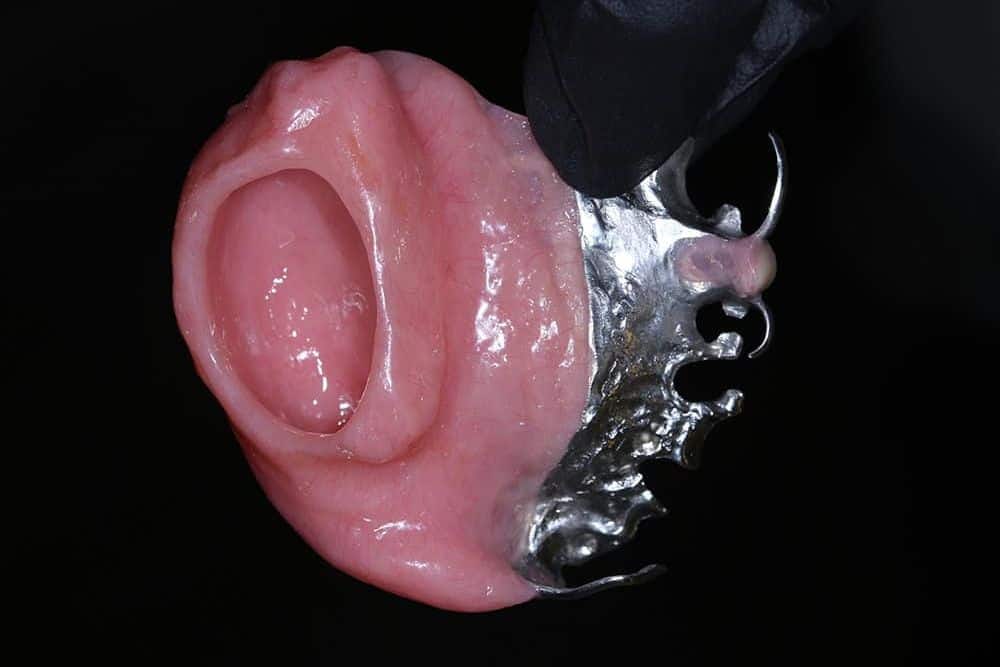
The Obturator
Anything he drank came out of his nose.
Maxillary cancer had taken part of his upper jaw. The surgery that saved his life left an opening where the roof of his mouth used to be, and with it gone, his mouth and his nasal cavity were one space.
Eating, drinking and speaking all depend on those two being separate. He needed a barrier built.
And what it costs
When a tumor is resected from the upper jaw, what remains is an opening between the mouth and the nose.
The consequences are immediate and total. Liquids and food regurgitate through the nose. Speech becomes hypernasal, because air escapes upward instead of being shaped by the mouth. Chewing is compromised, and so is the support the upper lip and cheek depend on.
None of that is repairable by surgery alone. It is closed prosthetically.
From the Latin for “to block up”
An obturator is a removable prosthesis that separates the oral and nasal cavities, restores speech and swallowing, and supports the lip and cheek.
Dilip's is a closed palate obturator. It seals the defect completely, giving him back a roof to his mouth.
Because no two resections are the same
Maxillectomy defects are categorized by where the resection sits relative to the teeth that remain, and that classification determines the entire prosthetic design: where support comes from, where retention is possible, and which forces the prosthesis will have to resist.
The system most widely used was established by Aramany in the Journal of Prosthetic Dentistry in 1978, and it sorts partially dentate maxillectomy patients into six classes by the pattern of the resection: midline, unilateral, central, bilateral, posterior and anterior.
Reading the defect correctly is the first clinical act. Everything that follows is determined by it.
A prosthesis for each phase of healing
Obturation is not one appliance. It is three, and the sequence matters.
The surgical obturator is made before the operation and placed immediately after the resection, in theater. It holds the surgical packing, reduces contamination of the wound, and allows the patient to speak and swallow in the immediate postoperative period, which removes the need for a nasogastric tube.
The interim obturator follows as healing progresses, relined and modified repeatedly as the tissues change shape, keeping speech and swallowing working throughout.
The definitive obturator is made once the tissues have stabilized, and it is the one built to last.
A rigid object in a moving space
Here is the central problem, and it is what makes this among the most demanding work in prosthodontics.
The prosthesis is rigid. The tissues around it are not. They move constantly, with every word, every swallow, every expression. The seal has to hold through all of that movement, and it has to hold without hurting him anywhere, through every position his anatomy passes through.
Then there is everything else it has to be at the same time. Stable, so it stays where it is put. Retentive, drawing support from the remaining palate, the ridge, his own teeth and the structures within the defect itself. Hollow in the bulb, to reduce weight and improve the resonance of his voice. Hygienic, in a form he can clean. Aesthetic. And above all phonetic, because being understood is what returns a person to their own life.
Each of those pulls against the others. Getting all of them simultaneously is the skill, and it is built across many careful stages rather than in one appointment.
Nobody would know
The video shows him with the prosthesis and without it, and the difference is not subtle.
With it in, he speaks completely normally. He eats. He drinks without anything reaching his nose. Nobody meeting him would have any idea he is wearing an obturator.
The surgery saved his life. This gave it back to him.
Without the obturator
With the obturator
The top of the same discipline
This sits in the denture section for a reason. It is the same fundamental problem as a denture, which is a prosthesis retained by anatomy rather than by teeth, taken to its limit.
Maxillofacial prosthodontics is where that training ends up: rebuilding not only teeth but palates, and in some cases ears and noses. Only prosthodontists are trained for it.
Which means that if you need a denture, the standard being applied to it comes from the same place as this. A practice that can close a cancer defect and make a man sound entirely ordinary when he speaks is not going to struggle with a conventional case.
Every case is planned around one person's anatomy. Individual results vary, and what was right for this patient may not be right for you.